Farm machinery plays an essential role in keeping agricultural businesses productive.…
From New Entrants to Returning Borrowers: Supporting the Next Stage of a Diversified Country Estate
From New Entrants to Returning Borrowers: Supporting the Next Stage of a Diversified Country Estate
For agricultural and rural businesses, the right funding requirement rarely happens just once. Farms, estates and diversified rural enterprises develop over time, and the finance that helps a business take its first major step may be very different from the funding it requires several years later.
One recent case demonstrates this particularly well.
We first supported these borrowers when they were purchasing a country estate and entering farming for the first time. Having successfully repaid their original UK Agricultural Finance facility, they have now returned to us as the estate enters its next stage of development.
This time, we have agreed a term loan of approximately £1.8 million, over a term of up to 84 months, secured against an estate valued at approximately £3 million–£3.5 million.
Supporting new entrants into agriculture
When the borrowers initially approached UK Agricultural Finance, they were experienced businesspeople but new entrants to farming.
They had successfully built and operated businesses within the care sector and also had established property income. However, they did not have the farming track record normally expected by many mainstream agricultural lenders.
Their ambition was to acquire an underdeveloped beef farm and create a diversified country estate that could support several generations of their family.
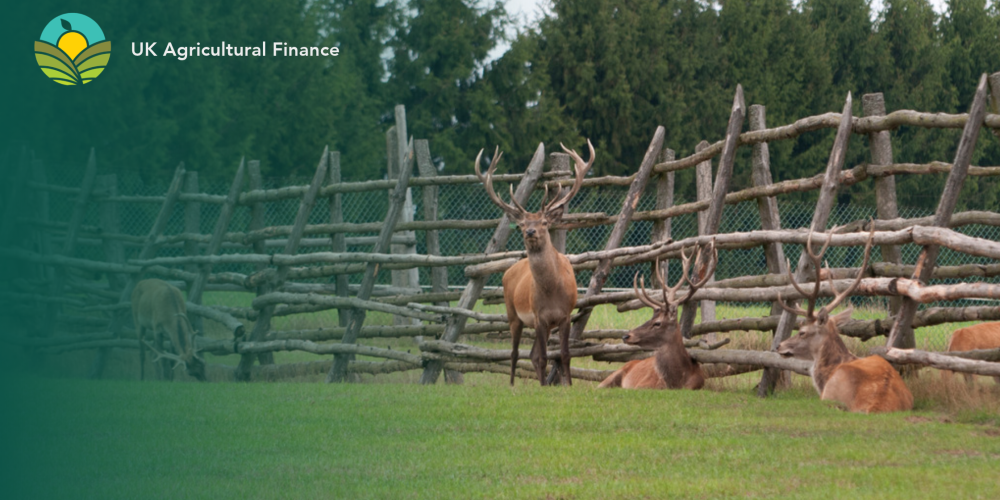
The plans included transitioning the livestock enterprise from beef to deer farming, alongside developing additional sources of revenue from the estate. These included caravan storage, timber and woodland income, property development and rental opportunities.
At the time, the lack of historic financial information for the existing farming business presented a further challenge. The property was being purchased as part of a distressed sale, meaning the borrowers were largely relying on their business plan and projections to demonstrate what the estate could become.
Rather than looking solely at their lack of previous farming accounts, UK Agricultural Finance considered the wider picture.
The borrowers had considerable commercial experience, established outside income and a clearly considered plan for the estate. Importantly, they also recognised where specialist agricultural expertise was required and sought professional advice as they developed their plans for deer farming and the wider diversification projects.
That allowed us to look at the strength of the borrowers, their existing businesses and the potential of the underlying agricultural assets rather than assessing the proposition purely against historic farm accounts.
A facility of a little over £1 million enabled them to purchase the estate and begin putting those plans into practice.
Returning to UK Agricultural Finance
Several years later, the original UK Agricultural Finance loan has been repaid and the borrowers have returned to us for further funding.
Much has changed since that first application.
The family has continued developing the estate, including establishing the deer-farming enterprise and creating residential accommodation for two generations of the family.
Deer farming, however, is not an enterprise that reaches commercial scale overnight. Building sufficient livestock numbers and establishing the resulting trading history takes time.
Consequently, while the estate has developed considerably since the original purchase, the agricultural enterprise does not yet have the level of historic standalone income that some traditional lenders would require when considering a facility of this size.
The borrowers also continue to operate successful businesses away from the estate.
This was an important part of our assessment.
Looking at income across the whole borrower proposition
Rural businesses increasingly combine several different activities and income sources. Assessing them effectively can therefore require looking beyond one set of farm accounts.
In this case, UK Agricultural Finance was able to consider income generated from the borrowers’ established businesses alongside the developing estate enterprise when assessing the affordability of the new facility.
Some lenders may be uncomfortable relying on income outside the farming operation, particularly where part of the agricultural enterprise is still developing its trading history.
Our approach allowed us to consider the borrowers’ overall financial position, the progress they had already made with the estate and the substantial underlying security.
The new facility will provide approximately £1.8 million over a term of up to seven years and will be secured against the country estate.
Funding the estate’s next stage
The new borrowing has two principal purposes.
Firstly, the borrowers want to continue investing in and developing the estate’s infrastructure as they work towards completing their longer-term plans.
Secondly, they have taken advice from their accountant and financial adviser about their wider financial and estate-planning position. Borrowing has been recommended as part of the steps being considered to manage a potential inheritance tax liability.
The precise role of borrowing within any tax or estate-planning strategy is, of course, a matter for borrowers and their professional advisers. From our perspective as lender, our role is to assess whether the borrowing proposition itself is appropriate and sustainable.
For these borrowers, their established external businesses, developing rural enterprise and strong asset position gave us the confidence to consider further funding.
A long-term lending relationship
One of the most positive aspects of this case is that it shows what specialist agricultural lending can help borrowers achieve over a longer period.
When we first met the borrowers, they were new entrants with an ambitious plan but without the agricultural track record required by mainstream lenders.
We were able to understand the commercial experience they brought from elsewhere, the professional advice supporting their plans and the potential of the estate itself.
They subsequently repaid that loan.
Today, they are returning customers, several years further into developing the estate and its deer enterprise, seeking finance for the next stage of their plans.
The anticipated exit from the new facility is through refinancing once further trading history has been established and/or through a future partial sale of other business interests.
For us, the case is a useful reminder that agricultural lending is rarely about looking at one number in isolation. Understanding the assets, the people behind the business, the different sources of income and what the borrower is working towards can reveal a much stronger proposition.
If you are advising a farming or rural business whose circumstances do not fit the standard criteria of traditional lenders, speak to UK Agricultural Finance about whether we could help.

Related Posts