Renewable energy projects can offer farmers and landowners opportunities to diversify…
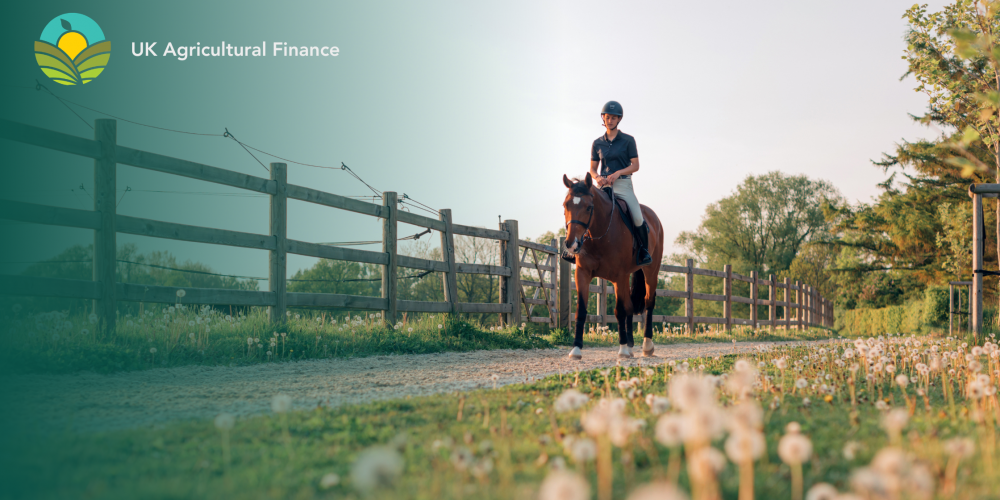
£780,000 Refinance Supports Long-Established County Durham Farm and Equestrian Business
£780,000 Refinance Supports Long-Established County Durham Farm and Equestrian Business
A diversified rural business does not always fit neatly into a conventional agricultural lending model.
For one husband-and-wife team in County Durham, income comes not only from farming, but from a successful livery yard, kennels, equestrian activities, agricultural contracting, fishing rights and a fibre-optic installation situated on the farm.
When an existing secured facility was approaching maturity, the borrowers needed to refinance quickly.
Following an introduction from a high-street banking contact who was unable to assist with the requirement, UK Agricultural Finance provided a £780,000 term loan over 84 months, secured against the family’s long-held farm at a day-one LTV of approximately 44%.
The facility enabled the borrowers to repay their existing lender and provided a modest amount of additional funding towards the next stage of their rural diversification plans.
More Than 140 Years of Family Farming History
The farm has been in the borrower’s family since 1881 and was once part of a considerably larger family farming enterprise, with agricultural property and land across County Durham.
Over successive generations, the wider estate was divided between family members.
The current borrower ultimately acquired his brother’s share of the farming property inherited from their grandparents, and today he and his wife operate the business together.
Both bring significant experience.
The husband has spent his working life in agriculture and now combines the farm with an increasingly active agricultural contracting business.
His wife has more than 30 years of equestrian experience, including formal training, and takes primary responsibility for the livery and equine side of the operation.
That combination of agricultural and equestrian knowledge has enabled the couple to gradually build several complementary sources of revenue around the assets available on the farm.
A Working Farm with an Established Equestrian Business
UK Agricultural Finance Business Development Manager Louise visited the borrowers shortly after the initial introduction.
The security comprises approximately 136 acres of Grade 3 pastureland, together with an extensive range of agricultural and equestrian buildings.
The main holding includes more than 30 traditional brick and stone buildings used as stables, two manèges, substantial modern agricultural buildings, livestock accommodation and machinery storage.
A further group of buildings provides additional machinery storage, office space and kennels.
The site visit confirmed that this was a genuine working agricultural and equestrian business rather than a rural property with diversification plans that existed only on paper.
The livery yard currently accommodates around 40 horses, with a mixture of DIY, part and full-livery arrangements.
Additional income is generated through dressage events, rustic rides, grazing and kennels.
Alongside the equestrian operation, the borrowers maintain a suckler herd of approximately 30 cattle and calves and rent a further 30 acres to produce hay for the livestock and equestrian enterprises.
Diversification Beyond Farming
Some of the less conventional features of the holding also contribute meaningful income.
The property includes fishing rights over a stretch of the River Wear, providing an additional revenue stream independent of the core farming operation.
There is also a fibre-optic installation on the holding that generates regular rental income.
Although neither activity might traditionally be considered part of a farming business, both contribute towards the overall financial strength of the enterprise.
This was an important part of UK Agricultural Finance’s assessment.
Understanding a diversified rural business means looking at all credible and sustainable sources of income rather than considering agricultural turnover in isolation.
The borrower has also recently invested in new baling machinery and begun securing agricultural contracting work, adding another complementary income stream that makes use of his existing experience and equipment.
Refinancing an Existing £750,000 Facility
The immediate requirement was driven by the maturity of the borrowers’ existing secured loan.
Approximately £750,000 of the new UK Agricultural Finance facility was used to repay that borrowing, which was carrying an interest rate of approximately 11%.
The borrowers had experienced delays in obtaining the financial information required to progress their refinancing, meaning the existing facility had gone beyond its intended term.
Once UK Agricultural Finance became involved, Louise was able to visit the farm quickly and gain first-hand understanding of the business, its assets and the different income streams supporting affordability.
The application was made directly, without a broker, and progressed with the support of an experienced local agricultural solicitor.
The resulting £780,000 facility was predominantly a refinance rather than funding for speculative expansion, and was secured at a conservative LTV of approximately 44%.
Building on an Existing Diversification Strategy
The remaining loan proceeds will contribute towards groundworks associated with the borrowers’ proposed introduction of two glamping pods.
Rather than representing a completely new direction for the business, the accommodation would complement activities already taking place on the farm.
The rural location, fishing rights and established equestrian facilities provide a potential basis for developing a broader leisure and tourism offering.
The borrowers intend to continue testing and expanding these opportunities progressively, alongside growth in agricultural contracting and greater use of their existing equestrian infrastructure.
Future development will, where applicable, remain subject to the necessary permissions and commercial assessment.
The important point is that the proposed accommodation is only one part of a much wider business.
Affordability of the UK Agricultural Finance facility is based on established trading activities rather than being dependent upon the success of an unproven tourism project.
Improving Trading Performance
The business has also demonstrated a significant improvement in recent financial performance.
Although historic accounts were affected by delays and changes in professional advisers, more recent trading information shows profitability moving strongly in the right direction.
Approximate net profit increased from around £25,000 in 2024/25 to approximately £88,000 in 2025/26.
The livery and equestrian businesses remain the principal contributors, supplemented by rental income from the fibre-optic installation, fishing rights and the farm’s other activities.
A Route Back to Mainstream Lending
The borrowers intend to continue operating and developing their diversified farming business throughout the seven-year term.
In time, their preferred route is to refinance onto a mainstream agricultural or commercial mortgage once further trading performance has been demonstrated.
The combination of a substantial freehold property, improving profitability and several established revenue streams provides a foundation from which to work towards that objective.
For UK Agricultural Finance, the case demonstrates the importance of understanding what actually happens on a rural holding.
Accounts provide one part of the picture.
A valuation provides another.
But visiting the farm and understanding how the livery yard, livestock, contracting activities, fishing rights, kennels and even a fibre-optic installation contribute to the business can provide essential context when assessing whether a loan is sustainable.
In this case, refinancing the existing facility has given a long-established family farm a more appropriate financial structure while allowing the borrowers to continue developing the diverse rural enterprise they have built around it.
If an agricultural or rural business has several different income streams and does not fit neatly within a conventional lending model, UK Agricultural Finance can consider the wider business, its assets and the people behind it when assessing a funding requirement.

Related Posts