Modernising a dairy farm can improve efficiency, support animal welfare and…
When Mainstream Refinancing Is No Longer the Right Fit: £350,000 Rural Business Refinance
When Mainstream Refinancing Is No Longer the Right Fit: £350,000 Rural Business Refinance
A strong trading history and valuable agricultural property do not always guarantee that a rural business will fit a mainstream lender’s criteria.
For one experienced farming couple in the South West, an existing bank facility needed to be refinanced despite the borrowers continuing to operate two profitable, complementary rural businesses from their agricultural holding.
The requirement was not driven by business failure or a lack of underlying assets.
Instead, the borrowers needed a lender prepared to consider their current stage of life, the strength of the security, the profitability of the businesses and – importantly – a realistic repayment strategy that did not depend upon securing another refinance at the end of the term.
Introduced by David West of R&BS, UK Agricultural Finance agreed an approximately £350,000 term loan over 60 months, secured against the agricultural smallholding at an LTV of approximately 46%.
The case was handled by UK Agricultural Finance Business Development Manager Ryan Morley.
An Established Specialist Rural Business
The borrowers have developed two complementary businesses from their farm.
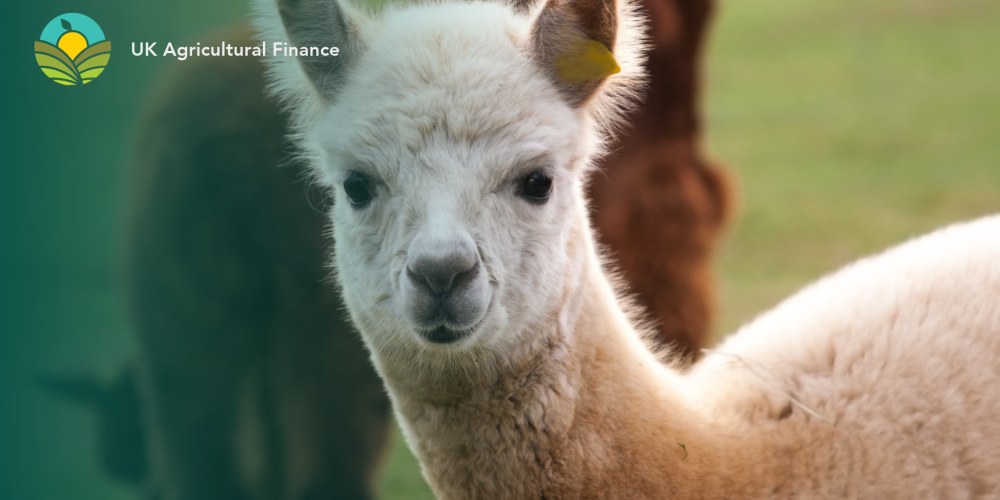
The first is an established specialist livestock enterprise centred on pedigree alpacas.
The business combines breeding and husbandry with livestock sales and specialist consultancy, drawing on the borrowers’ substantial experience within the sector.
Alongside this sits a separate fibre business processing and selling alpaca fleece products.
The business uses fibre from both the borrowers’ own livestock and other alpaca farms, processing it into yarn and related products for the craft and hobby market.
While the livestock enterprise produces a smaller profit, the fibre and yarn business has developed a significant turnover and has demonstrated improving profitability over the past three years.
The two activities therefore work together. One provides the agricultural and specialist livestock foundation of the enterprise; the other adds value to the raw product through processing and sale into a separate consumer market.
The borrowers also operate a shepherd’s hut holiday let from the holding, providing an additional recurring income stream.
Refinancing Existing Mainstream Borrowing
The principal requirement was to refinance approximately £350,000 of existing secured bank borrowing.
A small amount of additional working capital was also included in the facility.
Although the borrowers had an established business history and valuable agricultural assets, mainstream refinancing was no longer proving straightforward.
UK Agricultural Finance therefore assessed the proposition on its wider merits rather than looking only at whether the borrowers fitted a conventional high-street lending model.
That included considering the profitability and trading history of the businesses, the quality of the agricultural security, the borrowers’ plans for the next five years and the intended route to repayment at the end of the facility.
Agricultural Property with Several Income Streams
The security comprises an agricultural smallholding of around 30 acres.
It includes the borrowers’ home, modern agricultural buildings and yards, pasture divided into a number of field enclosures, and business premises associated with the fibre and yarn operation.
The holiday-let accommodation also sits within the wider holding.
The property therefore supports several connected rural activities rather than functioning solely as a residential asset.
At approximately 46% LTV, the £350,000 facility benefits from a substantial equity buffer.
That relatively conservative gearing was particularly relevant when considering the longer-term repayment strategy.
Continuing the Businesses Rather Than Winding Them Down Immediately
The borrowers intend to continue operating both businesses during the loan term.
Their plans are measured rather than speculative.
They expect to continue developing pedigree livestock sales, increase fibre processing and yarn activity, maintain specialist consultancy income and retain the holiday-let revenue.
They are also considering additional livestock accommodation to support the agricultural enterprise.
The important point is that the lending is not dependent on a dramatic expansion or an untested new venture.
Both core businesses are already trading profitably.
The strategy is to continue operating them, make modest improvements and preserve their value ahead of the borrowers’ eventual exit.
A Repayment Strategy Appropriate to the Borrowers’ Stage of Life
The repayment strategy was a particularly important part of the case.
Given the borrowers’ age, UK Agricultural Finance did not rely on the assumption that they would simply refinance the loan with another lender at the end of the five-year term.
Instead, the primary exit is expected to come from the eventual sale of the trading businesses.
Those businesses include established trading activity, specialist expertise, livestock assets and goodwill which may support an orderly sale as the borrowers move towards retirement.
A secondary repayment strategy is available through the agricultural property itself.
If required, part of the landholding could be sold to reduce or repay the facility.
Because the farm is relatively lightly geared, the borrowers have meaningful equity available within the property rather than relying solely on future trading performance.
This created a more credible repayment strategy than simply assuming another lender would be available at maturity.
Looking Beyond Standard Lending Criteria
This case demonstrates an important aspect of agricultural and rural finance.
Experienced borrowers can continue to operate profitable businesses and own substantial agricultural assets while finding that their circumstances no longer fit standard mainstream lending criteria.
That does not mean the risks should be ignored.
It means the proposition needs to be assessed on the basis of the business that exists today, the available security and a realistic route to repayment.
In this case, UK Agricultural Finance was able to consider two established rural businesses, relatively low gearing and an exit strategy based principally on an orderly business sale rather than an assumed future refinance.
The resulting £350,000, 60-month term facility allowed the borrowers to refinance their existing secured borrowing and continue operating the businesses while preparing for their longer-term exit.
For brokers and professional introducers, it is a useful reminder that a case does not necessarily become unworkable simply because an older borrower no longer fits the approach of a mainstream lender.
Where there is good agricultural security, viable trading activity and a credible repayment strategy, it can be worth looking at the full circumstances behind the requirement.
If you are advising an agricultural or rural-business client whose age, business structure or proposed exit means conventional refinancing is proving difficult, UK Agricultural Finance can consider the security, trading position and repayment strategy behind the application.

Related Posts